Sunday, 9 August 2026
Multiband Dipole Antenna for 10–80 Meters
Multiband Dipole Antenna for 10–80 Meters: Multiband dipole antenna covering 10, 11, 15, 20, 40, and 80 meters using loading coils and a matching section. Compact HF antenna requiring external tuner.

Friday, 15 May 2026
ZBitx: The Pocket SDR That’s Redefining Portable QRP
The world of QRP (low-power) amateur radio has seen remarkable innovation, and at the forefront of this movement is the ZBitx transceiver from HF Signals, the brainchild of Azar Farhan, VU2ESE. Following in the footsteps of the successful Bitx and sBitx series, the ZBitx is a tiny, all-band, all-mode Software Defined Radio (SDR) that’s capturing the imagination of hams looking for true portability for activities like POTA (Parks on the Air) and ZOTA (Zones on the Air).

Thursday, 14 May 2026
Hourglass Loop Antenna : A Stealthy Performer for VHF and UHF
If you’re hunting for a high-performance antenna that doesn’t look like a metallic porcupine, the Hourglass Loop (popularized by K4ERO) is a fantastic weekend project. It is essentially two delta loops stacked and fed in-phase, resulting in a bidirectional pattern with about 5 dB of gain over a standard dipole.

Unlike a typical 1-wavelength loop, the hourglass uses a 2-wavelength wire. The crossing point in the center acts as a phasing section, forcing currents in the top and bottom horizontal segments to be in phase. This creates a narrow vertical radiation pattern that puts your signal exactly where it needs to be: on the horizon.
Wednesday, 13 May 2026
DIY Antennas for LoRa and Meshtastic: A Complete Guide to 433, 868, and 915 MHz
LoRa radios offer incredible long-range, low-bandwidth communication—but only if your antenna is up to the task. A poor antenna can limit you to a few hundred meters, while a well-built DIY design can push past 20 km. The best part? You can build proven, high-performance antennas for just a few dollars.
This guide covers everything you need to build your own LoRa antennas for LoRa and Meshtastic 433 MHz (Europe/Asia/amateur radio), 868 MHz (EU), and 915 MHz (North America/Australia). You’ll find exact dimensions, construction tips, band-specific trade-offs, and real-world performance comparisons.

Stock antennas that ship with LoRa modules, Meshtastic nodes, and Helium Hotspots are typically tuned for minimal cost rather than maximum performance. They’re often mismatched to your specific frequency, use cheap materials, and have poorly characterized radiation patterns.
Monday, 11 May 2026
Getting Started with AIS: Track Ships from Your Shack with a RTL-SDR
The Automatic Identification System (AIS) is a VHF radio-based collision-avoidance protocol that virtually every commercial, passenger, and large recreational vessel in the world is required to carry. Since 2004, the International Maritime Organization (IMO) has mandated AIS transponders on all ships of 300 GT or more engaged in international voyages, all cargo ships of 500 GT or more on domestic routes, and all passenger ships regardless of size.

Every few seconds — sometimes as often as every two seconds when a vessel is manoeuvring — its AIS transponder transmits a compact digital burst on one of two dedicated VHF channels: 161.975 MHz (Channel 87B) and 162.025 MHz (Channel 88B). That burst contains a rich data payload: MMSI number (a unique vessel ID), ship name, call sign, IMO number, vessel type, dimensions, draught, destination, navigational status, GPS position, course over ground, speed over ground, rate of turn, and more.
Complete Guide to Budget Software Defined Radio : From $15 Dongles to Serious HF Receivers
Software Defined Radios have quietly rewritten the rules of radio listening. What once demanded a shelf full of dedicated hardware — separate receivers for HF, VHF, UHF, satellite — now fits into a USB dongle the size of your thumb. For hobbyists and shortwave listeners working on a tight budget, that shift is nothing short of revolutionary.
This guide covers the full landscape of affordable SDRs: what to buy at each price point, which software tools matter, and how to avoid the traps that catch most beginners.
Simple 2M VHF Sleeve Dipole Antenna for Rapid Field Deployment
When communication matters most, having an antenna you can build quickly from available materials becomes essential. The 2-meter Sleeve dipole antenna is one of the simplest and most reliable emergency VHF antennas you can assemble directly from the end of a transmission cable. With only a short whip, a piece of copper braid and an aluminium tube for stiffness, you can create a surprisingly efficient vertical radiator for 2 meters.

Building the Ultimate Multiband OCF Dipole for 40m-6m
Finding a single antenna that handles multiple HF bands without a mountain of complicated traps is a challenge. While many hams reach for a standard dipole, the Off-Center Fed (OCF) design offers a much smarter way to stay active on several bands. This specific design Multiband OCF Dipole, originally developed and tested by Rick Littlefield (W1BQT), serves as a reliable workhorse for the 40, 20, 10, and 6-meter bands.
By shifting the feed point, we tap into a “magic spot” where the antenna’s impedance stays relatively consistent across harmonically related frequencies. This makes it a perfect match for the standard 50-ohm coax found in most shacks today.

Friday, 8 May 2026
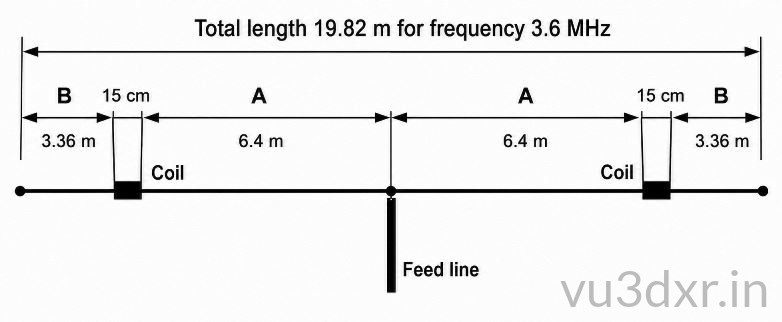
Compact 80 Meter Short Dipole Antenna for Small Spaces
One of the biggest challenges in amateur radio is finding enough space for low-frequency antennas. The 80 meter band is especially demanding because a conventional half-wave dipole requires nearly 40 meters of total wire length. For many operators, that simply is not possible.
Small urban plots, limited rooftop space, nearby buildings, and lack of suitable support points often make a full-size dipole impractical. Fortunately, there are several methods for reducing antenna size without completely sacrificing performance.
This short Dipole antenna for 80 meter is one of the more interesting solutions. By using loading coils placed at carefully selected positions along each arm of the antenna, the overall length can be reduced almost by half while still maintaining respectable efficiency and usable bandwidth.
Wednesday, 6 May 2026
End‑Fed & Long‑Wire HF Antennas
Terminated End Fed Vee Antenna (TEFV)
The TEFV is a terminated end‑fed Vee antenna intended for broadband HF coverage with minimal retuning. By accepting some efficiency loss in exchange for wide bandwidth and a quieter noise floor, it becomes a strong choice for multi‑band HF monitoring and casual operating. The article covers geometry, termination values, matching network and practical test results.
Multiband Half Wave End Fed Antenna
This multiband EFHW antenna uses a 1:49 transformer and carefully chosen wire length to cover several HF bands from a single feed point. It targets small‑plot or portable QRP operators who want 80 through 10 metre coverage with minimal hardware. Construction details, winding instructions and on‑air performance observations are provided for easy replication.
Building End Fed Half Wave Antenna (EFHW) for 40M – 10M
A practical EFHW focused on 40 to 10 metres gives solid multiband capabilities with a simple transformer and single wire. This project walks through transformer design, wire‑length tables, support options and tuning in real‑world conditions. It is aimed at portable, balcony and field operators who need quick deployment and predictable tuner behaviour.
Tree Mounted Quarter-Wave Vertical Antenna
The tree‑mounted quarter‑wave vertical shows how to hide an efficient HF radiator in plain sight by strapping it to an existing tree. Radials or counterpoise wires complete the system, giving low‑angle radiation for DX while remaining visually stealthy. The article explains mechanical fastening, wire routing, matching and on‑air performance from a typical suburban lot.
Antenna – Folded Beverage Antenna for HF Bands
This folded Beverage antenna is a receive‑only design built for serious HF DX listening with excellent noise rejection. It uses a long, low wire with specific folding and termination to achieve directional gain at low angles. The guide explains impedance, matching a 450‑ohm line to coax, termination design and how to protect the load from accidental RF power.
Rockloop & Loop‑Style HF Antennas
Rockloop & Loop‑Style HF Antennas
Antenna – Rockloop HF Antenna for 10,15,20 metre ham bands
The Rockloop is a compact multi‑turn HF loop aimed at 10, 15 and 20 metres, built from readily available tubing and a variable capacitor. It offers good efficiency from very small spaces with strong rejection of local noise, making it ideal for urban operators. The article walks through dimensions, mounting options and tuning methods so you can replicate the results.
Antenna – Foldaway Loop Antenna
This foldaway loop is designed for hams who travel or operate portable but still want serious HF capability. The loop collapses flat for storage yet can be deployed quickly in hotel rooms, balconies or rentals. The build covers mechanical hinges, conductor layout and tuning, showing how to achieve multiband coverage while keeping the antenna visually discreet.
Terminated Mini Loop Antenna: Small Space Ham Radio Antenna
The terminated mini loop trades raw efficiency for broadband coverage and low noise in very restricted spaces. Using a resistive load and compact loop, it covers a wide swath of HF without retuning, which suits SDR monitoring and casual HF listening in noisy apartments. The article details component choices, impedance matching and measured performance.
Loaded Loop Antenna – A Practical Balcony HF Solution
This loaded loop wraps an HF radiator around a balcony perimeter, using inductive loading to fit several bands into a compact rectangle. It’s aimed at operators with strict space or visual constraints, but who still want voice and digital contacts. The build shows mechanical mounting tricks, loading‑coil design and SWR results achieved from a real apartment installation.
HF Delta Loop Antenna
The HF delta loop is a full‑wave wire loop arranged in a triangular shape for improved low‑angle radiation and reduced noise pickup. It can be fed for different polarizations and offers a noticeable improvement over simple dipoles for DX work. The article explains dimensions, feed‑point options, matching techniques and real on‑air comparison results.
Aperiodic Multiband Wire Antenna: A Simple and Effective Design
This aperiodic multiband antenna is a non‑resonant HF wire using resistive termination and a broadband transformer for wideband coverage. It is ideal for SDR spectrum monitoring, utility listening and multi‑service monitoring where convenience trumps efficiency. The write‑up explains design theory, construction, measured return loss and when this approach beats traditional resonant wires.
Tuesday, 5 May 2026
3-Band HF Antenna: A Simple, High-Performance Design
3-Band HF Antenna: A Simple, High-Performance Design: Discover how to build a reliable 3-band hf antenna for 40m, 20m, and 10m. This modification uses an asymmetrical dipole and a toroid balun to deliver better SWR
Thursday, 30 April 2026
Low-Loss Feedline on a Budget: Building 450 to 600 Ohm DIY Ladder Line from Common Materials
Low-Loss Feedline on a Budget: Building 450 to 600 Ohm DIY Ladder Line from Common Materials: A complete technical guide to DIY ladder line for amateur radio. Build 450–600 ohm open-wire feedline cheaply, with less loss than coax on any HF band.
Monday, 27 April 2026
VHF DXing Secrets: The Ultimate Guide to Tropospheric Ducting for Radio Hams
Ever heard signals travel hundreds or even thousands of kilometers beyond line-of-sight? That’s not magic—it’s tropospheric ducting.
This fascinating radio phenomenon happens when atmospheric conditions (like temperature inversions and high-pressure systems) bend and trap VHF/UHF signals, letting them travel far beyond their normal range.
For ham radio operators, this means unexpected DX contacts, strong distant signals, and sometimes even interference from stations you’d never normally hear.
If you’re into radio, propagation, or just curious how the atmosphere can act like a giant waveguide, this guide is worth your time:
🔗 https://vu3dxr.in/ultimate-guide-to-tropospheric-ducting-for-radio-hams/
27MHz AM Transmitter Circuit for hobbyists
Explore the classic 27MHz AM Transmitter circuit. Learn about its oscillator, modulation, and power stages to build your own radio projects.
The 27MHz frequency band has long been a favorite among electronics enthusiasts and amateur radio operators. This citizen’s band frequency offers excellent propagation characteristics and serves as an ideal starting point for understanding amplitude modulation (AM) transmission principles. Today, we’ll explore a well-designed 27MHz AM transmitter circuit that demonstrates classic RF engineering concepts while remaining accessible to hobbyists.
Friday, 17 April 2026
The Silent Revolution: DRM+ Radio in the FM Bands
The Silent Revolution: DRM+ Radio in the FM Bands: Discover how DRM Radio in FM Bands revolutionizing global broadcasting in 2026. From xHE-AAC technology to "Green Radio" movement..DRM+ Radio in the FM Bands
Subscribe to:
Posts (Atom)